
Yoga is one of those things that can really divide the Christian community. One contingent says “it’s just stretching, it can’t be harmful”. Another contingent says “it’s part of Eastern Mysticism, Hinduism, New Ageism (or some other ‘ism’ that definitely isn’t Christian)”. My fence-sitting view is that both are right, or can be right, and the Christian does need to be careful about letting the enemy potentially sneak in the back door of something that feels harmless, but could potentially knock us off our walk.
I am an equestrian. I ride very large animals that have a mind of their own and can make unexpected, sudden movements. Before I started riding horses, I was a triathlete for many years. Bombing downhill on my racing bike at 45 or 50 mph with my feet locked into my pedals could also potentially result in some sudden, unexpected movements. Furthermore, I am getting older and starting to think about things like balance, flexibility, etc in my everyday life. I would love to learn dressage. In this discipline, balance, flexibility, posture, and strength are essential. Dressage riders are tasked with maintaining excellent posture while looking relaxed, and guiding a 1000 pound animal with cues that are essentially invisible to the average onlooker. There is no way to do this without the aforementioned necessities of balance, flexibility, posture, and strength. Enter yoga. I have found that the movements, stretches, and positions in the practice of yoga are absolutely the best way to gain those necessities. So I do yoga at home, I do yoga in the yoga studio, the bottom line is that I do yoga…and I am a Christian.

Do I have concerns about the potential spiritual pitfalls of yoga? Yes. I definitely do. It is absolutely true that yoga is an integral part of several Eastern religions. The practice arose in India, originally as a part of the Hindu religion. Buddhism and Jainism also incorporate yoga into religious practice. At this point, it is practiced to one degree or another by many people, probably in almost every religion. Certainly there are many people like myself that practice yoga only as part of a workout/exercise regimen. There are many others that enjoy the stretching, but also look for the calming and centering “spiritual” aspect of yoga, and still others that primarily focus on the spirituality of yoga. There are even different types of yoga that focus on different aspects of the practice. The question is, can you have one without the others? I believe the answer is yes, but it requires a lot of focus and intention, and I don’t believe that yoga is for every believer.
Let’s talk about “yoga words”. The word “namaste” has become very trendy. You can find it emblazoned on t-shirts, backpacks, baseball caps, and probably a thousand other things. I have been guilty of looking at my colleague at work, joining my thumbs and middle fingers, closing my eyes and jokingly chanting “om” when things are particularly crazy in the office. What do these words mean? “Namaste” is a Sanskrit word found in Hindu scripture that is an expression of veneration, possibly even worship. In modern yoga, it is loosely interpreted to mean “I bow to the divine in you”, or as you frequently hear in yoga studios today: “the light in me honors the light in you”. I intentionally do not say “namaste” at the end of a yoga practice in a studio because I know that Jesus is the light in me, and I am very sure that He does not bow to any Hindu, Buddhist, or Jain false god, nor does He honor the “light” in anyone that is not His light. The word “om” or “aum” is also a Sanskrit word. It’s possible meanings are diverse, but the word is universally recognized in Hinduism, Buddhism, and Jainism as a meditation tool to help connect you to the divine. Once again, I believe in the divine Triune God, and I am not going to try to “connect” to any false god of any Eastern mystical tradition by chanting their spiritual words. There are many people that don’t practice Hinduism, Buddhism, or Jainism who do say “namaste” and chant “om” and feel very strongly that it has nothing to do with anything religious. They feel that those words are just ways to “center” or “calm” yourself. I personally worry that dabbling in any false religion, even by “honoring the light” in others is a back door that the enemy can use against believers. I think it is a slippery slope that can start by saying “namaste” because you think it is respectful toward your yoga instructor and others in the studio, to chanting “om” to clear your mind and center yourself, and eventually falling into full blown Eastern or New Age meditation and prayer which leads to worshipping the earth (or something worse) and focusing fully on yourself during meditation rather than meditating on the things of God and praying to Him. The Christian must worship the Creator, not the created. 1 John 4:1-6 tells us very clearly that there are false prophets and spirits that are not from God. We are commanded to test the spirits to see if they are from God. Hindu false gods may be spirits, but they are not spirits from God.
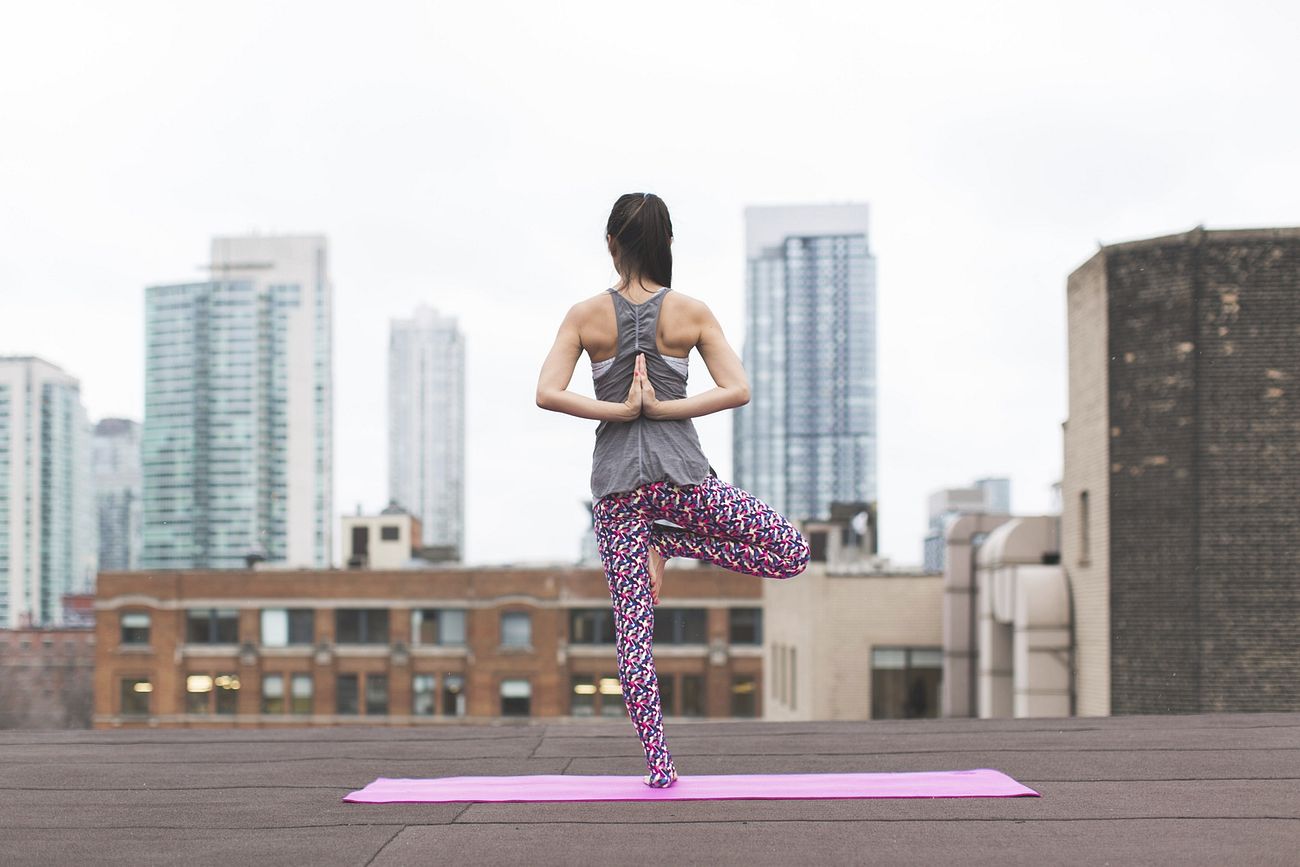
So what do I do instead during the times that the others in the room are chanting “om”, or the instructor is reading some kind of “spiritual reading”, or even when we are just laying on our mats at the end of the class? I pray. I pray to the Lord and list things that I am grateful for. I thank Him for my health, for His sacrifice on the cross, for the beauty of His creation. I pray for other people in the room, that they may recognize that He is the only true light that can be in us. I pray that He fills the room. When everyone says “namaste” at the end of the practice, I stay silent and bow before my Lord in prayer. One of these days, someone is going to notice my silence and ask me about it. I pray that the Holy Spirit guides my response and enables me to answer with truth and grace.
There is nowhere in the Bible that speaks specifically about yoga. But, I think there are passages that can be applied. I’ve already mentioned 1 John 4:1-6, one of the many passages that speaks against false gods. Let’s look at Romans for a minute. The entire chapter of Romans 14 teaches that certain foods may be permissible for one believer, but not for another, depending on each person’s degree of faith. Originally, this had to do with Peter’s vision described in Acts 10, in which a sheet filled with foods that were traditionally unclean were now deemed acceptable to eat. However, the passage in Romans clearly tells us not to cause another to stumble by eating what we accept as clean, if another believer in our presence does not feel the same. In my mind, this very much applies to yoga, as well as to any other personal potential stumbling block. Not every Christian is going to be comfortable practicing yoga. While I don’t believe that the stretches and movements are sinful in and of themselves, there are many believers that adamantly do believe exactly that, because of the Hindu background from which modern yoga was developed. I’m not going to argue with them, because I think that belief is completely reasonable. There are also many people that know that they may be susceptible to spiritual warfare in the setting of a yoga practice, even if they don’t believe that the stretches are inherently sinful. It would be wrong for those believers to do yoga, and it would be wrong for me to try to convince them that yoga is ok. Matthew 5:29-30 tells us that if our right eye or our right hand causes us to sin, it is better to lose those body parts than for our entire body to be thrown into hell. If you believe yoga is sinful, or if you know that you will open yourself up to spiritual warfare by practicing yoga, then don’t put yourself in that situation.
Are there options that don’t involve the Eastern mysticism side of yoga? Yes! I have found some online yoga instructors that merely lead you through a series of stretches and poses, without even adding a “namaste” at the end. There is also a movement toward using traditional yoga stretches and poses combined with guided Christian meditation. You may find these yoga classes advertised by many names such as “Christian Yoga”, “Holy Yoga”, or I’ve even seen it called “HoYo”. Some don’t use the word yoga at all. Unfortunately, in my small town, there is nothing except a fairly standard yoga studio complete with weird and slightly creepy eastern mystical wall hangings. This may explain why I tend to keep my eyes closed through most of the class.
In conclusion, I think the stretches and positions of yoga can be very beneficial for gaining balance, flexibility, and strength, but overall it can be very dangerous if you don’t guard your heart and mind carefully. I believe every Christian needs to know his or her own “triggers” that can lead away from following hard after Jesus, and avoid them at all cost. If you are a Christian that practices yoga, I would challenge you to really think about which pieces of the practice are beneficial, and which you need to avoid or guard against.


 seekinghimaboveallelse.com
Leave a reply to krolen1 Cancel reply